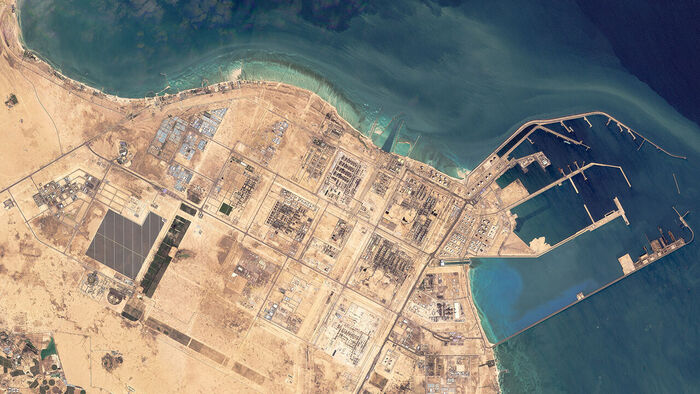
▲ Ras Laffan Industrial City, a major LNG hub in Qatar
An internal explosion has occurred at the Ras Laffan Industrial City in Qatar, the world's largest liquefied natural gas (LNG) hub, leaving 18 people missing and at least 54 injured.
The Qatari Ministry of Interior stated on June 21 (local time) that "an internal explosion occurred at a plant within the Ras Laffan Industrial City following a technical incident," adding that civil defense teams have been deployed to manage the scene.
QatarEnergy, the state-owned energy company, explained that the explosion and subsequent fire took place at the Barzan Gas facility within the industrial complex while staff were working to restart the export terminal on that day.
QatarEnergy added that the accident occurred during the "start-up of operations" at the Ras Laffan Industrial City.
While authorities initially reported only a small number of injuries, they later announced significantly higher casualty figures.
AFP reported that flames and columns of smoke were visible from 20 kilometers south of the industrial complex.
The accident in Qatar, one of the world's largest LNG producers, has raised concerns about potential disruptions to the global energy market.
Ras Laffan Industrial City is the world's largest LNG hub, where gas produced from nearby offshore fields is brought in, liquefied, and exported globally.
Spanning 295 square kilometers, the complex houses not only LNG processing facilities but also various gas and oil-related infrastructure, including LNG storage, condensate separation facilities, and refineries.
The Barzan plant, where the accident occurred, has the capacity to produce approximately 1.4 billion standard cubic feet (SCF) of sales gas per day.
Qatar has primarily used this gas for local power generation and to operate seawater desalination plants across the Arabian Peninsula.
The explosion appears to have occurred during the process of restarting facilities at the Ras Laffan Industrial City that had been suspended following attacks by Iran.
Amid the war between the United States and Iran that began in late February, the Ras Laffan Industrial City suffered significant damage from successive Iranian drone attacks, leading to a suspension of operations.
At that time, the state-owned QatarEnergy declared "force majeure," stating it could no longer fulfill existing LNG contracts.
QatarEnergy had previously estimated that the Iranian attacks, centered on the Ras Laffan Industrial City, reduced Qatar's total LNG export capacity by 17% and that it would take 3 to 5 years to restore the destroyed facilities.
Qatar is the world's third-largest LNG exporter.
The Ras Laffan Industrial City, often referred to as the "heart" of Qatar's LNG industry, has accounted for approximately 20% of the global LNG supply.
It is known that 90% of the LNG produced there is destined for the Asian market.
According to statistics from the Korea International Trade Association, South Korea imported a total of 6.97 million tons of LNG from Qatar last year, accounting for 14.9% of its total LNG imports (46.72 million tons).
This makes Qatar the third-largest supplier, following Australia (31.4%) and Malaysia (16.1%).
(Photo: AP, Yonhap News)
※ Please note: This article was translated by AI and may contain errors.